Client work
DebtClear
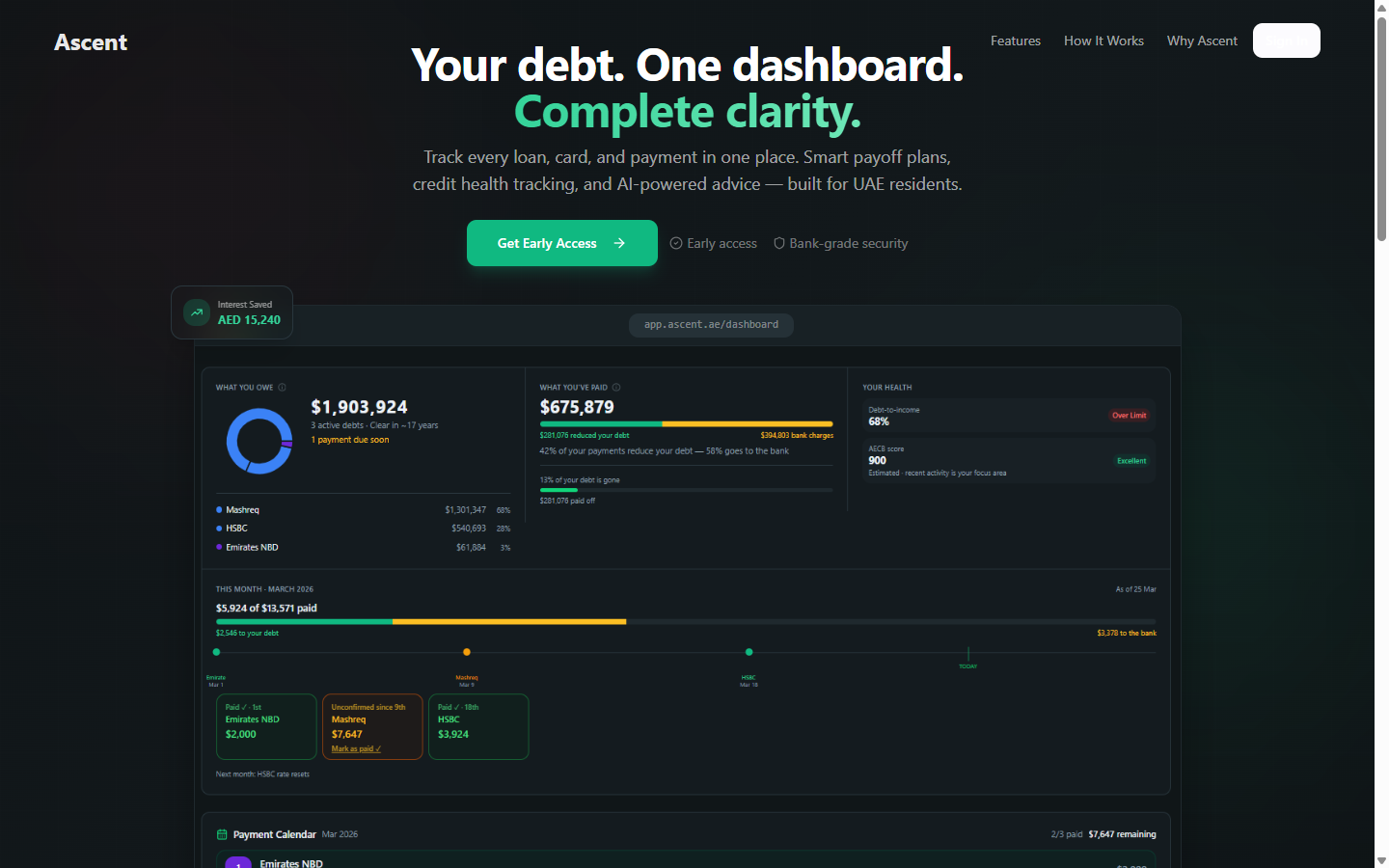
A personal debt dashboard for UAE residents, shipped as Ascent. Users log every loan, card, and BNPL plan in one place; the app runs the amortization, projects payoff dates, and tracks credit health on an AECB-style 300 to 900 scale.
Client-owned product. Live at ascent-cjf.pages.dev. Repository: github.com/Arzisoft/debtclear.
The problem
UAE residents typically hold debt across several banks: a mortgage at one, a car loan at another, two or three credit cards, maybe a personal loan or an off-plan property schedule. The banks don't talk to each other, the rates are quoted differently (flat vs reducing, EIBOR + margin vs fixed), and a person trying to pay things off in the right order has to do the math by hand. DebtClear consolidates all of it into one dashboard and one monthly plan.
What we built
- Unified debt dashboard
Seven debt types in one grid: mortgage, auto, personal, credit card, BNPL, overdraft, off-plan. One balance, one monthly total, one clear payoff date.
- Payoff planner
Avalanche, snowball, and hybrid strategies simulated month-by-month with dynamic credit-card minimums and leftover redistribution.
- What-If engine
Natural-language scenarios (“add AED 500 monthly”, “refinance the car at 4.5%”) scored against a baseline in real time.
- Trust score
AECB-style 300 to 900 scale rebuilt from the user's actual payment history and utilization, with no credit bureau lookup required.
- Rate feeds
Variable loans track EIBOR + bank margin (basis points) and recalculate automatically when the rate feed syncs.
- Debt auditor
Detects math discrepancies between what the bank charged and what the amortization schedule said, and flags likely overcharges.
How the numbers work
UAE banks quote personal and auto loans as a “flat rate”, and the interest is charged against the original principal for the whole term, even though the balance drops every month. The true reducing-balance APR is nearly double the flat number. A 4% flat rate over five years works out to roughly a 7.87% real APR. The dashboard surfaces both figures so users see what they're actually paying.
Some banks only hand the customer a principal, a monthly instalment, and a term, with no quoted rate at all. The planner reverses out the APR from those three numbers directly, using an iterative solver that converges on the right rate in a fraction of a second. Once the APR is known, the rest of the amortization follows.
Variable loans (most UAE mortgages and some personal loans) aren't quoted as a single rate. They're stated as an EIBOR tenor (one, three, six or twelve months) plus a bank margin in basis points. A nightly job syncs the latest EIBOR values from the rate feed, and every schedule rebuilds itself against the new numbers. When the market moves, the dashboard moves with it.
The payoff planner then simulates the months ahead under three strategies. Avalanche funnels the surplus into the highest-APR debt first, minimising total interest paid. Snowball funnels it into the smallest balance first, producing faster early wins to keep the user motivated. Hybrid splits the surplus between the two. Credit-card minimums are recomputed each month as the greater of AED 100 or 5% of the balance, and whenever a debt hits zero mid-month, the payment it used to absorb rolls straight into the next target so no month is wasted.
Stack
React and Vite on the front, Tailwind and shadcn/ui for the design system, Recharts for the graphs, Framer Motion for motion. Supabase handles auth, Postgres with row-level security, and the edge functions behind schedule rebuilds, rate-feed syncs, and AI insights. TanStack Query keeps the dashboard reactive.